The problem with coding agents is not their code. It is that you cannot merge it.
Anvil Coder takes a ticket from your backlog and delivers a pull request in which every step has been checked and can be traced before you see it. The backlog shrinks. You only decide.
Tuesday, 2 pm: six agent PRs of 800 lines each in the queue, stand-up in an hour. And you are the bottleneck.
You read a diff and have to reconstruct why the agent built it that way, because there is no trail.
The rules file was there. The agent nodded and wrote straight past the repository layer into the database.
The agent bill arrives. Nobody knows which project used what.
Anvil Coder turns that around: a ticket is split into small work steps, each runs under the same guardrails, leaves its own commit and has to pass a gate before the next phase begins. What reaches you is a draft pull request, and you read on the commit which assignment it came from.
Watch the work happen, decide at the end
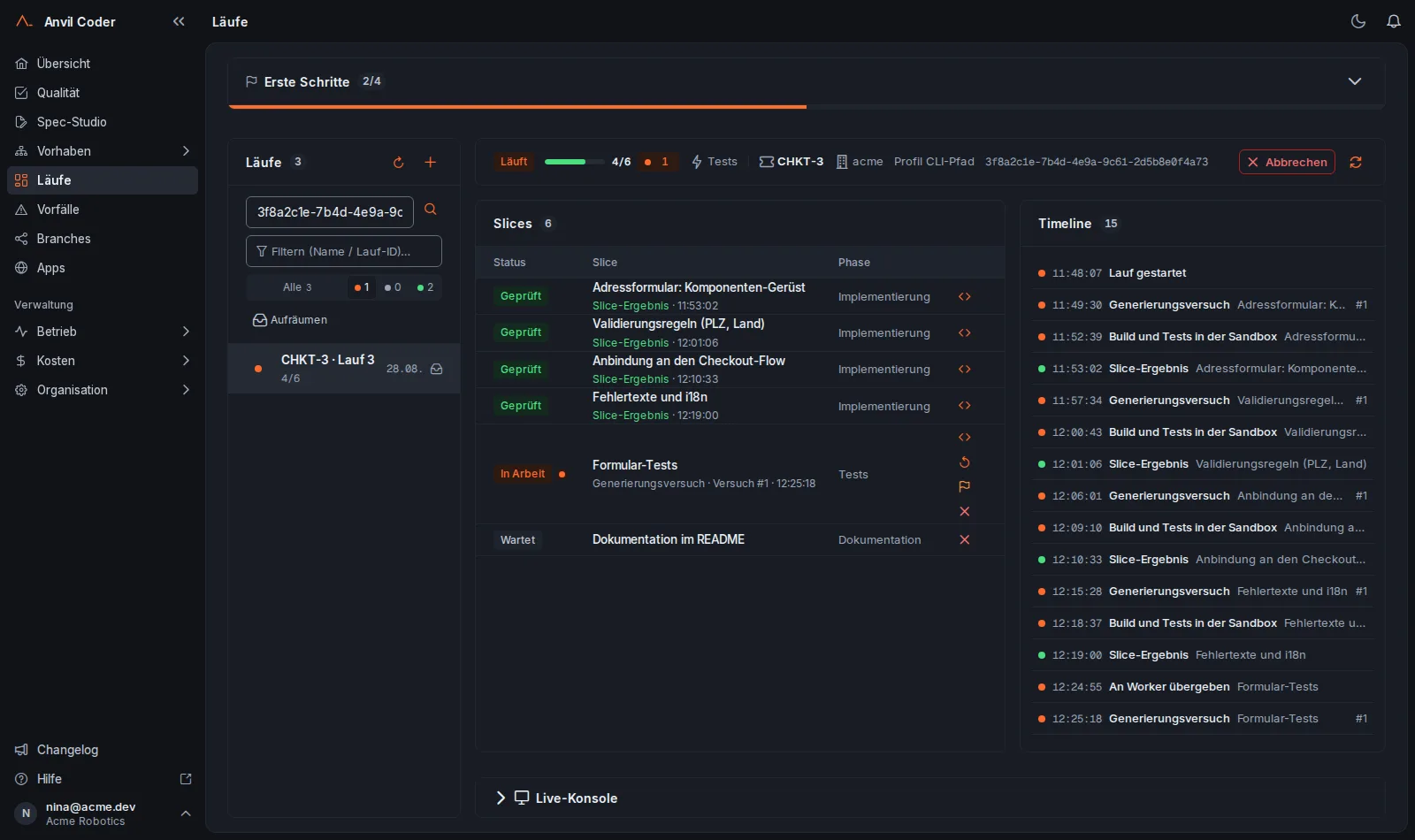
The cockpit shows every work step as it completes, runs or waits, with its cost next to it. The pull request lands in your code host, where you review anyway.
The run overview in the cockpit, example data, German interface.
A real run, measured
A Laravel bug from the tracker became three commits in 24 minutes: the fix, the follow-up in six dependent files and a regression test, with no human intervention. The sandbox lacked the PHP toolchain, so the run reported the test as unverified instead of claiming green.
You keep your process: your repository on GitHub, GitLab or Bitbucket, your tickets in the internal board, Jira, YouTrack, GitHub or GitLab, your model provider with your own key. Java with Spring Boot is the most thoroughly proven path;here is how you bring your stack.
Turn a requirements text into epics and stories your team can prioritise.
What does Anvil Coder cost?
One Team subscription per organisation covers ten seats and includes runtime credit for your runs; beyond that you pay for what you use. Every project shows its own costs, and a cap per run holds before it hurts.
No, the result arrives as a draft pull request in your repository, and a human merges it. How much you want to approve during the run is a per-project setting.Details: Review and supervision
Yes, the service runs on the Infomaniak Public Cloud in Switzerland. Model requests go to the provider you configure, and the result goes wherever your repository lives.Where the data lives: Security: where the data lives
How do I keep control?
Supervision is a per-project setting: from “every action needs an approval” to “only the consequential ones”, or no intermediate approval at all. The merge stays with you either way.Why that is the real question: For product teams: hand over the execution, keep the decision
With Google Analytics we see which pages are read. Google loads only if you accept; your browser remembers your choice, no cookie from us, and you can change it any time in the footer. Privacy policy